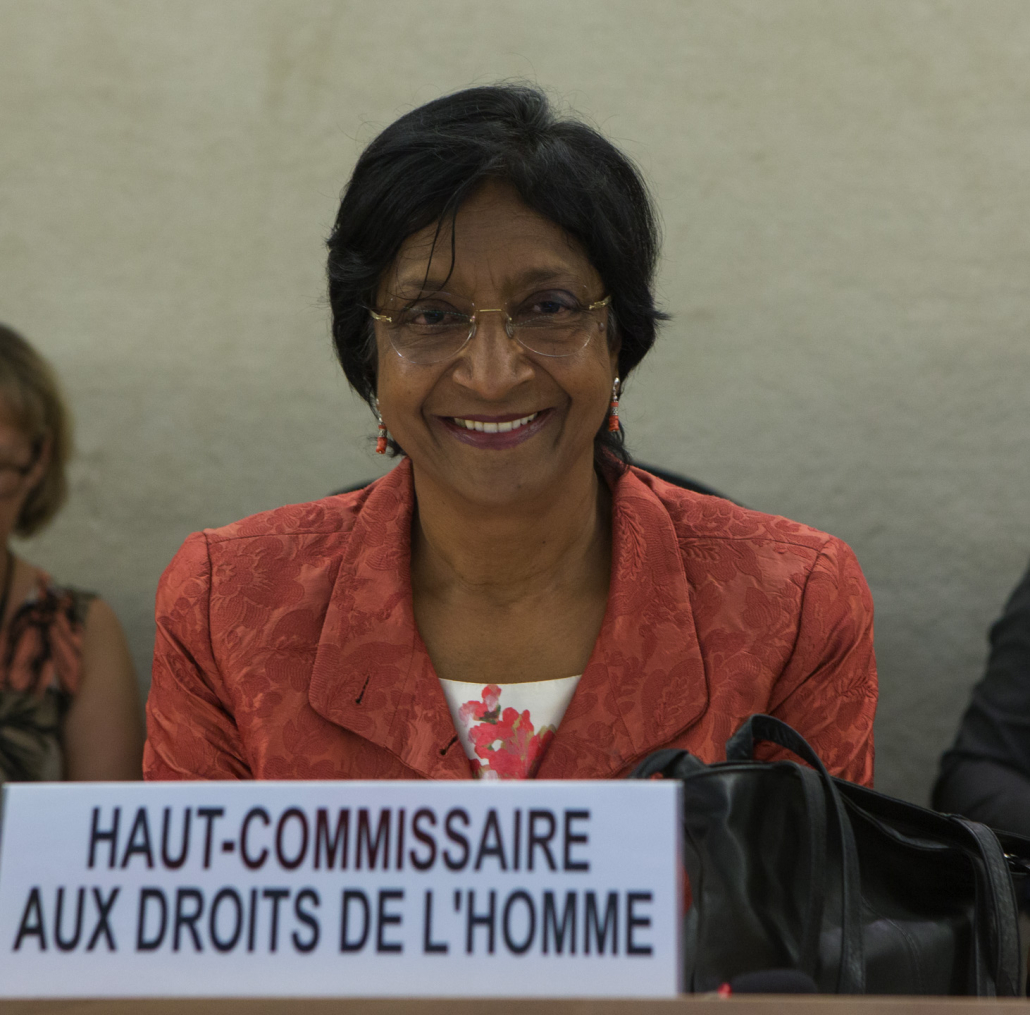
 Photo: Navi Pillay at the UN Human Rights Council, 10 June 2014. © U.S. Mission Geneva / Public Domain.

Nobel Peace Prize Winner Navi Pillay’s Statements on Ukraine in 2014
The new Nobel Peace Prize winner, Navi Pillay, is mostly known for her approach towards Israel, which critics have described as one-sided. What some may have forgotten is that she was the UN High Commissioner for Human Rights during the first Russian invasion of Ukraine in 2014.
If we take a look at her statements from that time, some comments seem not merely anachronistic but deeply disturbing. Russia is in some cases not even mentioned [1][2], while there are cases of statements that show signs of bothsidesism regarding the Ukrainian government and the so-called „separatists“. Pillay also explicitly mentioned the rights of Russian-speaking Ukrainians, a talking point that was (and is) very widespread in Russian propaganda.
Since the start of the Russian full-scale invasion 2022, Pillay has made few publicly documented statements about Ukraine.
Quotes:
„We were unable to get hard evidence of the supply of weapons,“ Pillay said in comments carried by ITAR-Tass. [3][4]
„It is extremely important that the authorities themselves demonstrate full respect for the rule of law and scrupulously protect the human rights of all, including the Russian-speaking population.“ [1]
„I urge all sides to make a much greater effort to find a peaceful resolution.“ [1]
„There has been strong hate speech from all sides.“ [2]
Pillay also faced criticism over statements issued by the UN Human Rights Office during her tenure in 2012, when her spokesperson described Charlie Hebdo’s cartoons as „malicious and deliberately provocative“ and criticized their publication as „doubly irresponsible.“
The UN-critical NGO UN Watch published a study in 2011 examining Pillay’s statements published on the UN website between September 2008 and June 2010. According to the study, numerous authoritarian states received little or no attention in the publications examined.
Pillay’s tenure as UN High Commissioner for Human Rights has also faced criticism, including from UN whistleblower Emma Reilly over the UN’s handling of Chinese dissidents and Uyghur activists.
Links
[1] UN Office of the High Commissioner for Human Rights (May 6, 2014): Ukraine Crisis: Much Greater Effort Needed From All Sides Towards Peaceful Resolution. Official statement mentioning the rights of Russian-speaking Ukrainians and calling for a peaceful resolution. Russia is not explicitly mentioned as an actor in the conflict.
https://www.ecoi.net/en/document/1188379.html
[2] UN Office of the High Commissioner for Human Rights (July 4, 2014): Navi Pillay Says Intensified Fighting Is Putting At Risk The Lives Of People In Donetsk And Luhansk. Official statement addressing escalating violence and hate speech, including Pillay’s reference to hate speech from all sides. Russia is not explicitly mentioned as an actor in the conflict.
https://www.ecoi.net/en/document/1173487.html
[3] The Moscow Times (2014): UN Says ‚No Hard Evidence‘ of Russia Supporting Ukraine Insurgency. Reports Pillay’s statement about the absence of hard evidence of Russian weapons supplies, citing ITAR-TASS.
[4] StopFake (2014): Office of UN High Commissioner for Human Rights Did Not Conduct an Investigation of Separatists‘ Arms Delivery Sources. Fact-check explaining that Pillay’s office had not investigated the origins of weapons supplied to separatists, despite Russian media using her statement to dispute Russian involvement.
[5] RIA Novosti / GlobalSecurity (August 1, 2014): Russian reporting documenting Moscow’s reaction to Pillay’s statement about the lack of hard evidence for Russian weapons deliveries.
https://www.globalsecurity.org/wmd/library/news/ukraine/2014/ukraine-140801-rianovosti02.htm
Dietmar Pichler ist Chief Analyst und Redakteur bei INVED und verfügt über umfassende Expertise in den Bereichen Desinformation, Medienkompetenz und ausländische Einflussnahme. Er analysiert Desinformationskampagnen sowie propagandistische Einflussstrategien autoritärer Regime. Neben seiner Tätigkeit bei INVED ist er als freiberuflicher Medienkompetenztrainer, Berater für strategische Kommunikation und Desinformationsanalyst in Wien tätig. Er ist Vizepräsident der NGO „Vienna Goes Europe“ und Gründer der Initiative „Disinfo Resilience Network“, die sich der Vernetzung von Fachleuten zur Aufdeckung und Einordnung hybrider Bedrohungen widmet.